A conveyor is an essential part of material handling in factories, warehouses and packaging lines. It moves products, components, cartons or bulk material between production stages with limited manual handling. A properly designed conveyor can support a steadier flow, reduce unnecessary handling and help integrate equipment in an automated end-of-line packaging system.
Main components of a conveyor system
- Frame: The supporting structure, commonly made from coated steel, stainless steel or aluminium profiles.
- Conveying surface: Depending on the product, this may be a PVC, PU or rubber belt, a modular plastic belt, rollers or a metal mesh.
- Drive and idler drums: In a belt conveyor, the drive drum transmits motion to the belt; the idler helps guide and tension it.
- Motor and gearbox: These provide the drive. A variable-frequency drive can be used where adjustable speed is required.
- Rollers and idlers: These support the load and help guide the belt.
- Sensors and controls: Photoelectric sensors, limit switches and PLC controls can coordinate the conveyor with other equipment.
- Tensioning system: Correct belt tension helps limit slipping and maintain stable operation.
Types of conveyors and their applications
| Type | Construction and typical use | Main consideration |
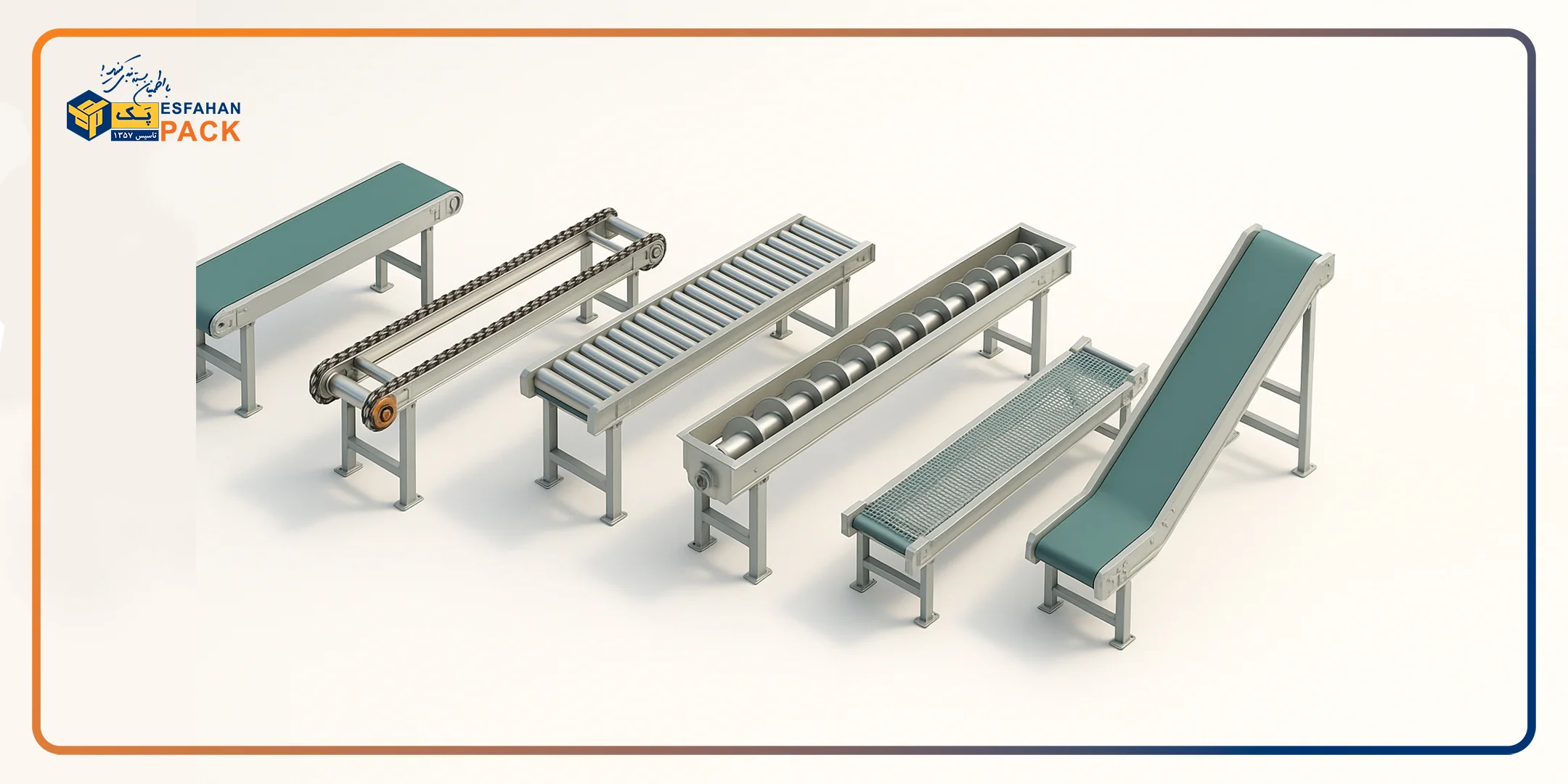
| Belt conveyor | PVC, PU or rubber belt for packages, cartons and components in production, packaging and warehousing | Continuous transport; select the belt for the product and load |
| Gravity roller conveyor | Unpowered rollers move suitable goods by gravity or manual force | Simple transfer for flat-bottomed cartons and end-of-line operations |
| Powered roller conveyor | Motor-driven rollers for cartons, larger boxes and pallets | Controlled movement; capacity depends on the design |
| Flexible conveyor | Expandable roller or wheel construction for changing loading and unloading routes | Flexible length and layout |
| Incline conveyor | Belt, often fitted with cleats or sidewalls, carries products between elevations | Choose the incline and retaining features for the product |
| Chain conveyor | Loads move on one or more chains, commonly for pallets and heavy items | Suited to demanding applications when designed for the load |
| Modular conveyor | Interlocking plastic conveying surface, often used in food and hygiene-sensitive environments | Washability and replacement of individual modules depend on the design |
| Screw conveyor | A rotating screw moves powders or granules inside a tube or trough | Often used for enclosed bulk-material transfer |
Belt and roller conveyors
Belt conveyors are versatile for carrying packages, cartons and parts. Gravity rollers are useful for warehouse exits, inspection stations and the ends of packaging lines where the load and slope allow unpowered movement. Powered rollers are appropriate when controlled movement of heavier cartons or pallets is required.
Flexible, inclined and chain conveyors
Flexible conveyors can be extended or repositioned for truck and container loading. Incline conveyors bridge height differences, while cleats or sidewalls can help retain products. Chain conveyors carry loads directly on chains and are often chosen for pallets or demanding industrial conditions.
Modular and screw conveyors
Modular belts can simplify cleaning or local component replacement when the system is designed for those tasks. Screw conveyors transport bulk products such as flour, sugar or animal feed; material characteristics and hygiene requirements determine the final specification.
Benefits in a factory
Continuous movement can reduce waiting between stages and the need for repeated manual handling. A conveyor can also help organise product flow and integrate with sensors and controls. The actual improvement depends on the layout, load, safeguarding, maintenance and performance of the whole line.

How to choose a conveyor manufacturer
Rather than relying on a claim of being the “best”, assess suppliers against your project requirements:
- Experience with comparable applications and references.
- Ability to design for the product and the available line layout.
- Construction quality and suitability of the frame, rollers, drive and conveying surface.
- Availability of spare parts and maintenance support.
- Installation, commissioning and technical support arrangements.
- Integration with upstream and downstream packaging machinery.

What to consider before buying a conveyor
Define the product’s weight, dimensions, shape and required throughput. Specify the route length, height changes and working environment, including cleaning and food-contact needs where relevant. Select the conveying surface, frame and motor to suit the load and operating conditions. Confirm speed control, sensors and PLC interfaces, and ask about spares and service before purchasing.
In an automated packaging line, a conveyor may feed a shrink wrapping machine, a palletizer or a pallet stretch wrapping machine. The conveyor speed, transfer points and control logic must be coordinated with the equipment actually installed.
Why supplier experience matters
Poor sizing, unsuitable components or weak integration can cause downtime, wear and expensive rework. A supplier that understands the process can help define interfaces, simplify maintenance and design a more reliable material flow. Verify specifications and support commitments for the individual project.

Frequently asked questions
What is the difference between a belt conveyor and a chain conveyor?
A belt conveyor carries products on a continuous belt and is often used for light to medium loads. A chain conveyor carries the load on chains and is frequently used for pallets or heavier-duty applications. Suitability always depends on the system’s rated design.
What affects conveyor price?
Length, width, carrying surface, frame material, motor, control system, load capacity and customisation all affect the quotation.
Does a conveyor need regular maintenance?
Yes. Inspect belts, rollers, bearings, motors, gearboxes and tensioning components at intervals specified by the manufacturer. Isolate energy and follow the applicable safety procedures before maintenance.
Which conveyor is appropriate for food production?
The choice depends on the product, contact surfaces and cleaning process. Stainless steel frames and washable PVC, PU or modular belts may be suitable when they meet the specific hygiene and food-contact requirements.
Can a conveyor be integrated with automatic packaging equipment?
Yes. Appropriate sensors, PLC interfaces and controls can coordinate a conveyor with equipment such as shrink wrappers and palletizers. The integration must be engineered for the particular line.