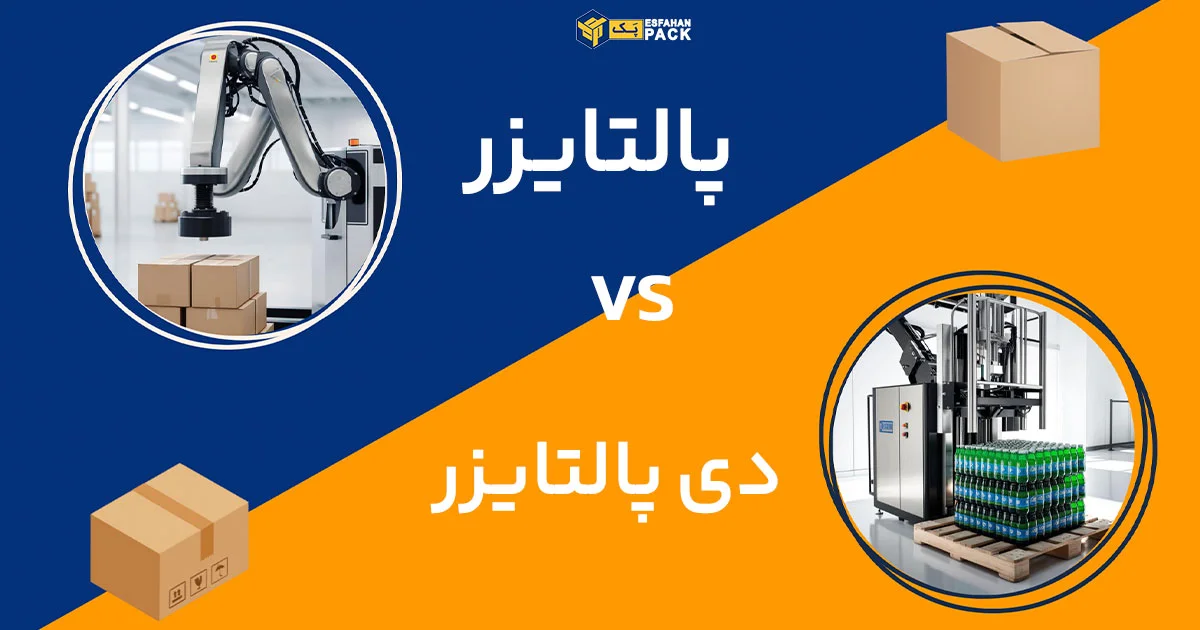
A palletizer places products onto a pallet in a planned pattern. A depalletizer performs the reverse operation: it removes products or layers from an incoming pallet and feeds the next process. The direction of material flow determines the gripping tools, conveyors and auxiliary equipment.
What does a palletizer do?
At the end of a packaging line, a palletizer arranges cartons, bags or other suitable units into a stable load. Conventional layer systems and robotic arms are possible approaches. Selection depends on product stability, weight, capacity and pattern; a completed load may then pass to a pallet stretch wrapper.

What does a depalletizer do?
At the start of a line, a depalletizer unloads a pallet and transfers products to a conveyor or accumulation table. Empty bottles, jars and cans are common examples. Robotic, layer-handling and other mechanisms are selected according to container shape and sensitivity.

Key differences
- Flow: a palletizer builds a load; a depalletizer separates a load into products or layers.
- Position: palletizing usually serves the end of the line; depalletizing often feeds an upstream process.
- Tools: jaws, vacuum, clamps or layer heads must suit the specific product and its allowable pressure.
- Pallets: a palletizer may use an empty-pallet dispenser; a depalletizer needs an empty-pallet removal or stacking arrangement.
- Tier sheets: placement between layers and removal during unloading require different handling systems.
- Downstream equipment: palletized loads may be wrapped or stored; depalletized containers can move to rinsing, filling or another operation.

How to select the right system
Define the product, filled or empty condition, weight, fragility, pallet dimensions, layer pattern and target rate. Examine available space, conveyor direction, sheet handling, safe access and integration with existing machines. Include maintenance, parts, training and future changeovers in the cost comparison.
Controls and safety
Robotics, product and pallet sensors, sheet detection and programmable patterns can improve flexibility when correctly designed. Risk assessment and suitable guards, interlocks and emergency stops must be specified for the actual installation.
Frequently asked questions
Can a palletizer be converted into a depalletizer?
Some robotic systems can be engineered for both tasks, but changing a program alone is not necessarily enough: tooling, conveyors, controls, sheet handling and safety may differ.
Which is faster?
There is no universal answer. Compare equivalent products and units of measure; a layer-handling depalletizer may move many containers at once, while pallet rates depend on the system.
Which has a better return?
Assess the actual bottleneck and economics. An incoming-container line may benefit from depalletizing; an end-of-line stacking bottleneck may justify palletizing.