
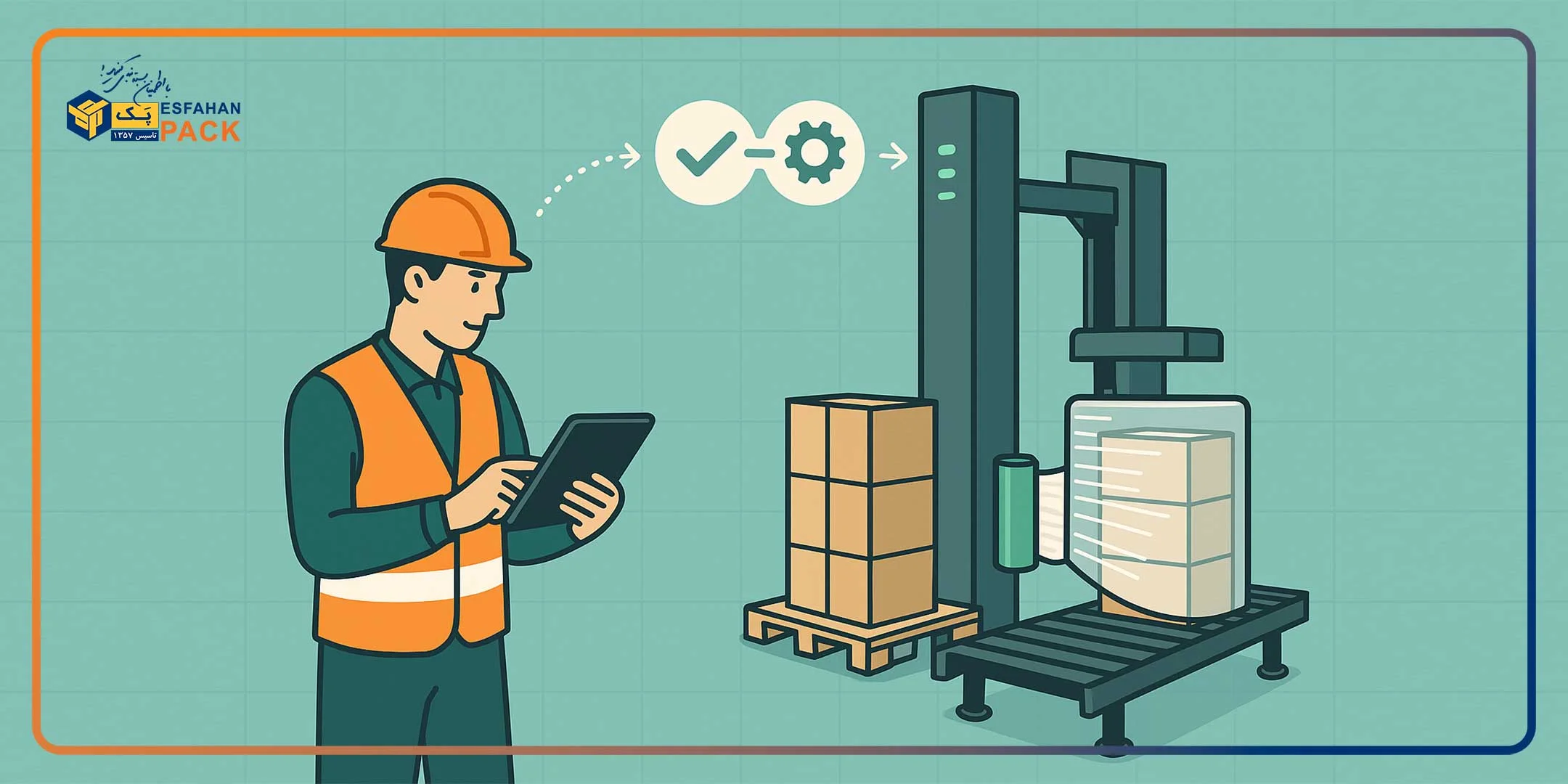
Packaging machinery can improve labour productivity by shifting operator time from repetitive handling to inspection, adjustment and process control. The objective is more good output per working hour, not simply fewer people. Results depend on the product, equipment, line layout and operator training.
Why manual packaging can become a bottleneck
Wrapping, sealing, carrying and stacking by hand can vary with experience and fatigue. Rework and short stoppages may constrain output even when more staff are added. Measure the actual bottleneck before deciding which step to mechanize.

How machines change operators’ work
A suitable automatic or semi-automatic packaging machine can repeat settings such as sealing time, conveyor speed and film tension. This may reduce variation and allow staff to focus on quality checks, materials, maintenance and line monitoring. Pallet stretch wrappers and shrink wrapping machines can also reduce repetitive physical handling when properly integrated.
For illustration, 500 packs at 50 seconds each require about 6.9 hours of packing time; at 20–25 seconds, the theoretical time is about 2.8–3.5 hours. Actual savings must allow for loading, downtime, changeovers and the rest of the line.

Manual, semi-automatic or automatic?
Manual work has low initial equipment cost but depends heavily on operators. Semi-automatic equipment mechanizes selected steps and may fit a smaller or varied operation. Automatic equipment can integrate repeated steps at higher volumes but requires more investment and coordination. Choose the level that resolves the measured constraint.
Measure productivity and total cost
Record saleable packs per labour-hour, rejects, rework, stops, film use and output by shift. Compare purchase, installation, energy, maintenance, training and downtime with achievable benefits. Reassigning staff to quality or other work can create value even when headcount does not change.
Choosing equipment
- Measure actual demand, shifts and the slowest step.
- Document product dimensions, weight, material and variation.
- Check space, utilities, safety and compatibility with conveyors.
- Assess maintenance, spare parts, training and future capacity.
- Trial representative products and verify quality before scaling up.
Frequently asked questions
Does automation eliminate operators?
No. Machines still need trained people for setup, checks, maintenance and supervision; staffing depends on the installation.
Is automatic equipment always better?
No. A semi-automatic machine may be sufficient when volume, budget or product variety make a full line impractical.